Spray Foam vs. Blown-In Insulation: Which Is Right for Your Navajo County Home?
If you've started researching insulation options for a home in Snowflake, Taylor, or anywhere else in the White Mountains, you've probably run into the same question twice: spray foam or blown-in? Both materials show up constantly in insulation marketing, and both genuinely work — but they solve different problems, and the right choice depends on what part of your home you're insulating and what condition it's starting from. This guide breaks down how each performs in a real Climate Zone 5 house, where winter lows regularly sit in the high 20s and snow is a normal part of the season, not an occasional event.
Before getting into the comparison, it helps to remember why this matters more here than it would in low-desert Arizona. At roughly 5,600 feet of elevation, Snowflake and the surrounding Navajo County communities fall under IECC Climate Zone 5 — the same general insulation-performance category used across much of the northern United States. The target for an attic here is in the R-49 to R-60 range, with walls typically built to around R-20, because the job of insulation in this climate is to hold heat inside the house through a real winter, not just to blunt summer afternoons.
How the two materials actually work
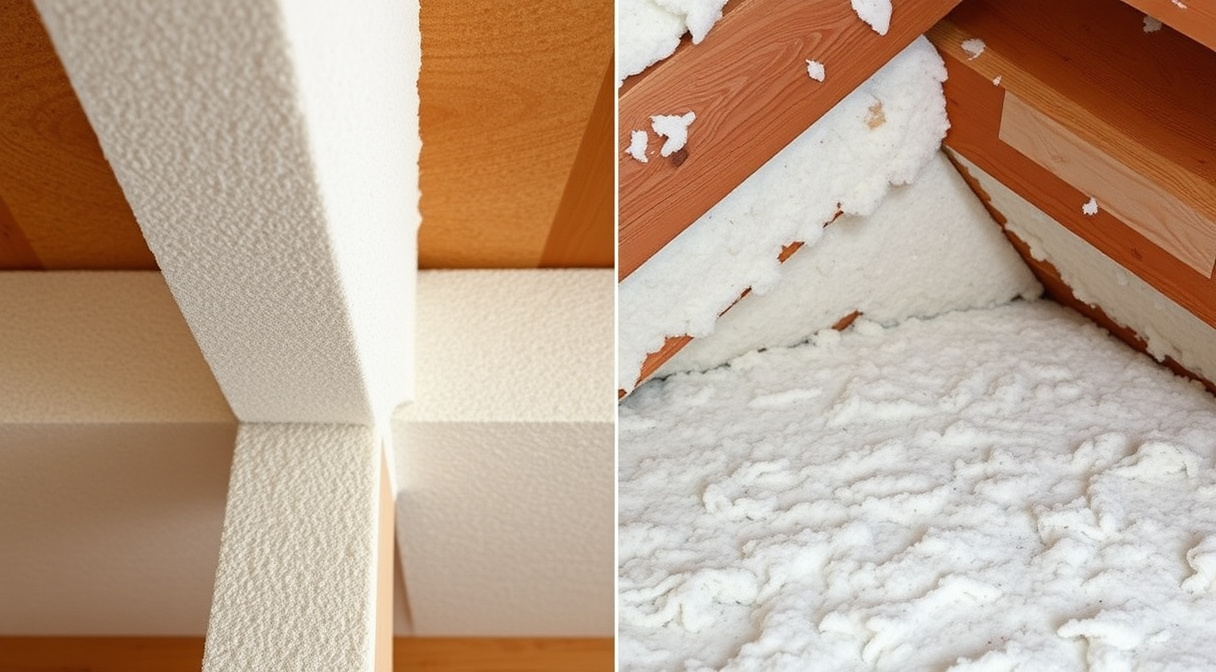
Blown-in insulation — usually cellulose or fiberglass — is loose material blown through a hose into an attic floor or an enclosed wall cavity. It settles around obstructions like wiring, plumbing, and framing, filling space without needing much demolition. Spray foam is a liquid that's sprayed in place, where it expands and cures into a solid, air-sealing layer that bonds to the surface it's applied to.
R-value per inch: the real technical difference
This is where the two materials diverge the most. Closed-cell spray foam generally delivers a higher R-value per inch than blown-in cellulose or fiberglass, which means it can hit a target R-value in less physical thickness — useful in tight rafter bays, rim joists, or shallow wall cavities where there isn't much depth to work with. Blown-in insulation needs more depth to reach the same R-value, but attics typically have plenty of depth to work with, so that's rarely a limiting factor there.
Air sealing: the piece a lot of homeowners miss
Insulation alone slows heat conduction, but it does very little to stop air leakage — and at altitude, with wind-driven cold and dry winter air, uncontrolled air leakage is a major source of heat loss and cold drafts. Spray foam air-seals as it expands, closing gaps around penetrations, top plates, and rim joists in the same step that it insulates. Blown-in insulation does not air-seal on its own; if a home has significant air leakage, that needs to be addressed separately — typically with caulk, foam sealant, or weatherstripping — before or alongside a blown-in upgrade.
Cost considerations
Spray foam generally costs more per square foot installed than blown-in insulation, largely because of material cost and the labor involved in applying and curing it correctly. Blown-in insulation is typically the more budget-friendly option for large, open areas like a standard attic floor, which is why it's such a common choice for topping off older, under-insulated homes in Taylor, Show Low, and Pinetop without a full renovation. The right answer for most homes in this region isn't "pick one" — it's using each material where it performs best.
Where each option makes the most sense in a White Mountains home
- Attic floors in existing homes: blown-in cellulose or fiberglass is usually the practical choice — it covers irregular spaces quickly and gets an under-insulated attic up toward the R-49–R-60 range without major demolition.
- Rim joists and band joists: spray foam is well suited here because it air-seals and insulates a notoriously leaky, hard-to-reach area in one step — a common source of cold floors near exterior walls.
- Vaulted or cathedral ceilings with limited depth: spray foam's higher R-value per inch matters most where there isn't much cavity depth to work with.
- Crawlspaces and manufactured-home underbellies: spray foam's air-sealing performance helps protect exposed plumbing from freeze risk in unheated or semi-heated spaces.
- New wall cavities during construction or a remodel: either material can work, but the decision usually comes down to budget, wall thickness, and whether air sealing is being handled separately.
A lot of the most effective projects we see in Navajo County actually combine both: blown-in insulation across the bulk of the attic floor, with spray foam targeted at rim joists, the attic hatch, and other high-leakage points. That combination tends to deliver better real-world performance than either material used alone at the same budget.
What this means for heating costs and comfort
With natural gas largely unavailable in this rural service area, most homes here heat with propane or an electric heat pump — both of which get noticeably more expensive to run when a house is losing heat through an under-insulated attic, leaky rim joists, or uninsulated crawlspace. Whichever material or combination fits your home, the goal is the same: keep the heat you're paying for inside the house through a real Climate Zone 5 winter, rather than letting it escape through the roof and floor.
Every home is a little different — attic condition, wall assembly, ductwork routing, and existing insulation depth all factor into which material makes sense where. The most reliable way to get a real answer for your specific house is a walkthrough, not a guess based on square footage alone.
If you're weighing spray foam against blown-in for a home in Snowflake, Taylor, Show Low, or anywhere else in the White Mountains service area, call 844-967-5247 or email josh@contractorschoiceagency.com and we'll take a look at your attic, walls, and crawlspace and tell you plainly which combination makes sense for your budget and your winter.
Frequently asked questions
Neither one is universally "better" — they solve different problems. Blown-in is typically the most cost-effective way to bring an attic floor up to the R-49–R-60 range recommended for Climate Zone 5. Spray foam earns its place in rim joists, crawlspaces, and tight or vaulted spaces where air sealing and higher R-value per inch matter more than raw coverage area.
Yes. Spray foam expands and bonds to the surface it's applied to, closing gaps and penetrations as it cures. Blown-in insulation fills space but doesn't create an air seal on its own, so a home relying only on blown-in should have air leaks addressed separately for the best performance.
Ready for a free quote?
Tell us about your home and we'll build a clear quote — rebates included.